 Happy Pixels Lab
HappyPixelsLab Blog
Top 10 Website Design Trends in 2026
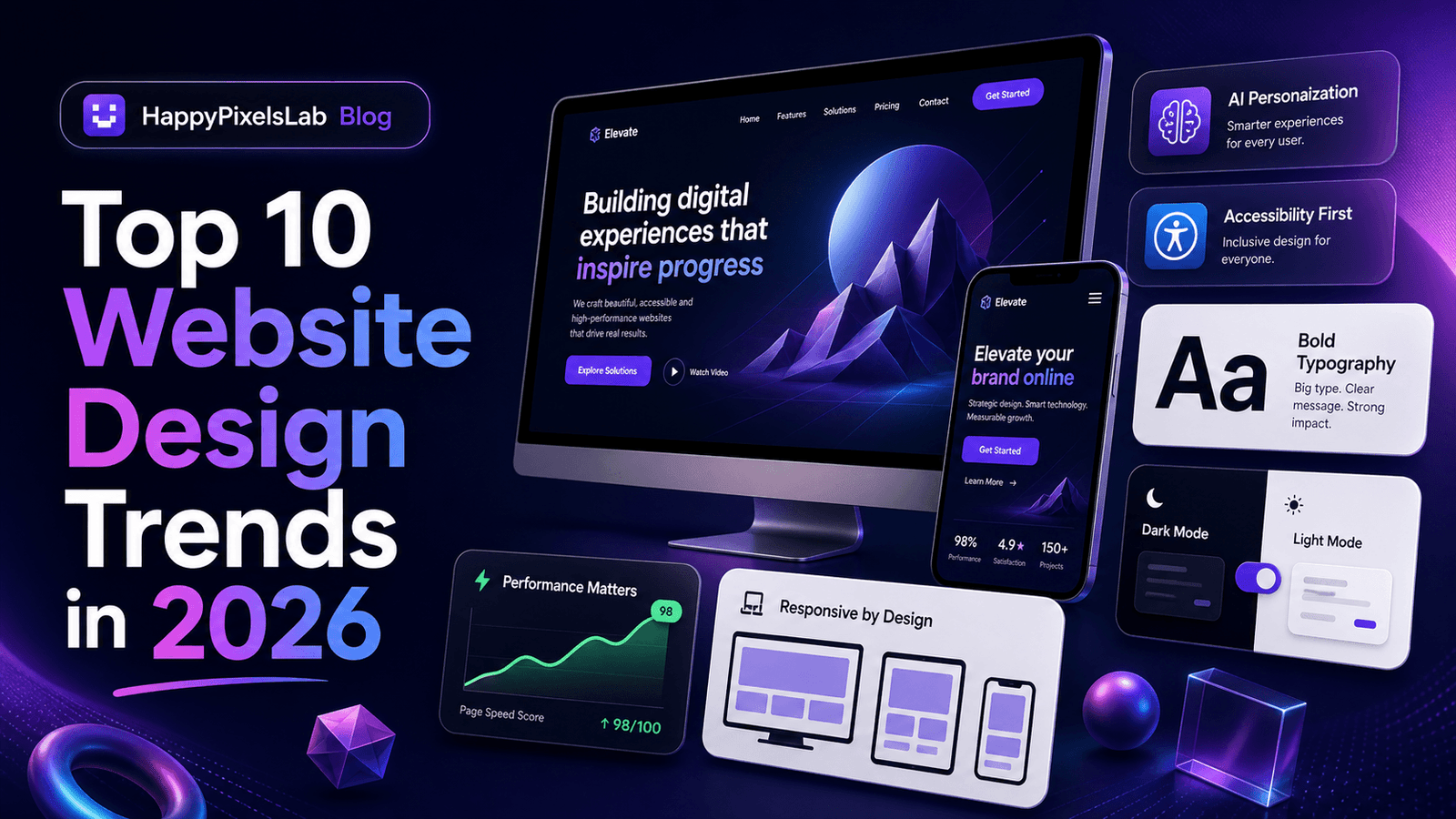
Top 10 Website Design Trends in 2026
Website design is changing faster than ever. In 2026, a successful website is not only expected to look beautiful. It must load quickly, work smoothly on mobile, feel trustworthy, support accessibility, guide users clearly, and help businesses generate leads or sales.
Modern users expect websites to feel simple, personal, fast, and useful. They do not want confusing layouts, slow animations, outdated visuals, or pages that only look good but do not help them take action.
At HappyPixelsLab, we design websites that combine strong branding, modern UI/UX, performance, SEO structure, and conversion-focused layouts. In this guide, we will explore the top 10 website design trends in 2026 that businesses should understand before redesigning or launching a new website.
Why Website Design Trends Matter in 2026
Website design trends are not only about visual style. The best trends solve real user problems. They make websites easier to use, faster to understand, more accessible, and more effective for business growth.
A modern website can help your business:
- Create a stronger first impression
- Build trust with potential customers
- Improve user engagement
- Generate more inquiries and leads
- Support better SEO performance
- Improve mobile user experience
- Increase conversions from paid and organic traffic
However, not every trend is right for every business. The best approach is to use trends that improve clarity, usability, trust, and conversions.
1. AI-Assisted Personalization
One of the biggest website design trends in 2026 is AI-assisted personalization. Websites are becoming smarter by showing more relevant content, recommendations, calls-to-action, and user journeys based on visitor behavior and intent.
For example, a service website can highlight different sections for different types of visitors. A startup founder may see messaging around speed and launch support, while a local business owner may see messaging around credibility and lead generation.
Good AI personalization should feel helpful, not intrusive. It should improve the user experience without making visitors feel tracked or uncomfortable.
Businesses can use AI-assisted personalization for:
- Smart content recommendations
- Personalized service suggestions
- Dynamic call-to-action messages
- Better chatbot support
- Product or portfolio recommendations
- More relevant landing page sections
The goal is simple: show the right message to the right visitor at the right time.
2. Conversion-Focused Minimalism
Minimalism is still important in 2026, but it is no longer about making a website look empty. The new approach is conversion-focused minimalism. This means every section, button, heading, image, and animation should have a purpose.
A clean website helps users understand your offer quickly. It removes distractions and guides visitors toward important actions such as contacting your business, booking a consultation, buying a product, or viewing your portfolio.
Conversion-focused minimalism includes:
- Clear hero sections
- Simple navigation
- Strong CTA buttons
- Short and useful copy
- Clean spacing
- Focused service sections
- Easy-to-scan layouts
A modern website should not overwhelm visitors. It should make the next step obvious.
3. Bold Typography and Expressive Headlines
Typography is becoming a major part of brand identity in 2026. Websites are moving beyond basic text styles and using bold, expressive, and memorable typography to create stronger visual impact.
Large headlines, creative font pairings, kinetic text, and strong typographic hierarchy can help a website feel premium and distinctive. Current design conversations also show a shift toward more expressive, emotional, and personality-driven type choices instead of overly generic digital minimalism.
Good typography can help your website:
- Communicate your brand personality
- Make key messages memorable
- Improve content readability
- Create a stronger hero section
- Guide users through the page
However, readability should always come first. A font may look stylish, but if users struggle to read it, it will hurt the experience.
4. Human-Centered Visuals and Authentic Design
In 2026, many brands are moving away from overly polished, generic visuals. Websites are using more human, warm, and authentic design elements to feel real and trustworthy.
This can include custom illustrations, real photography, hand-drawn elements, organic shapes, textured backgrounds, friendly mascots, natural gradients, and storytelling visuals. Design trend reports for 2026 also point toward more tactile, warm, expressive, and human-feeling visuals as a response to generic AI-style design.
Human-centered visuals can make a website feel more approachable and memorable. For service businesses, this is especially useful because trust plays a major role in getting inquiries.
Use authentic visuals such as:
- Real team photos
- Project screenshots
- Behind-the-scenes images
- Custom icons and illustrations
- Brand-specific graphics
- Client results or case study visuals
Good visuals should support the message, not just decorate the page.
5. Mobile-First Website Design
Mobile-first design is no longer optional. Many users visit websites from smartphones, so your website must be designed for mobile users from the beginning.
A mobile-first website should load fast, have readable text, large tap-friendly buttons, simple navigation, and short content sections. Forms should be easy to fill, images should resize properly, and important CTAs should be easy to access.
Mobile-first design best practices include:
- Readable font sizes
- Sticky or easy-to-find CTA buttons
- Fast-loading images
- Simple menus
- Short paragraphs
- Tap-friendly buttons
- Optimized forms
- Responsive layouts for all screen sizes
If your website looks great on desktop but feels difficult on mobile, you may lose a large number of potential customers.
6. Accessibility-First Design
Accessibility is one of the most important website design priorities in 2026. A website should be usable by as many people as possible, including users with visual, motor, hearing, or cognitive disabilities.
The Web Content Accessibility Guidelines, known as WCAG, provide recommendations for making web content more accessible. WCAG 2.2 is the current W3C recommendation and includes additional success criteria beyond WCAG 2.1. :contentReference[oaicite:1]{index=1}
Accessibility-first design includes:
- Strong color contrast
- Readable typography
- Keyboard-friendly navigation
- Descriptive alt text for images
- Clear form labels
- Visible focus states
- Helpful error messages
- Avoiding content that depends only on color
Accessible websites are better for users, better for trust, and often better for long-term SEO and usability.
7. Fast, Lightweight, Performance-First Websites
Speed is a major part of website experience. A slow website can frustrate users and reduce conversions. In 2026, performance-first design is one of the most important web design trends because users expect pages to load quickly and respond smoothly.
Google’s web.dev emphasizes building websites that are beautiful, accessible, fast, secure, cross-browser, and useful for all users. :contentReference[oaicite:2]{index=2}
Performance-focused website design includes:
- Compressed images
- Modern image formats like WebP
- Optimized fonts
- Reduced unnecessary scripts
- Lazy loading for images and videos
- Clean code structure
- Limited heavy animations
- Proper caching
A website should not become slow just to look modern. The best websites balance beauty and performance.
8. Immersive Visuals, Motion, and Microinteractions
Motion design is becoming more refined in 2026. Instead of using heavy animations everywhere, modern websites use purposeful motion to guide users, show feedback, and create a premium experience.
Microinteractions can include hover effects, button animations, smooth transitions, scroll effects, form feedback, progress indicators, and subtle icon motion.
Useful motion can help:
- Guide attention to important content
- Make interactions feel responsive
- Improve storytelling
- Show progress or success
- Create a more polished user experience
However, animations should never hurt readability, accessibility, or page speed. Motion should support the user journey, not distract from it.
9. Dark Mode and Adaptive Themes
Dark mode is now expected on many modern websites, especially technology, creative, SaaS, portfolio, and app-related websites. In 2026, users want more control over how they experience digital products.
A good dark mode is not just a black background. It requires carefully planned colors, surfaces, borders, shadows, images, icons, and readable text.
Modern adaptive theme design can include:
- Light mode
- Dark mode
- System default mode
- Accessible contrast settings
- Theme-aware illustrations
- Consistent CTA colors
For brand websites, dark mode can create a premium look when implemented properly. But it must be tested across all sections, including headings, subtitles, forms, cards, blog pages, menus, and footers.
10. SEO-Friendly Content Experience
In 2026, website design and SEO must work together. A beautiful website is not enough if users cannot find it through search engines. At the same time, SEO content should not feel robotic or stuffed with keywords.
Google recommends creating helpful, reliable, people-first content and using clear page titles, descriptions, headings, image alt text, and meaningful internal links to help search engines understand your pages. :contentReference[oaicite:3]{index=3}
An SEO-friendly content experience includes:
- Clear heading structure
- Helpful service pages
- Blog content that answers real questions
- Fast-loading pages
- Descriptive image alt text
- Internal links between related pages
- Readable content formatting
- FAQ sections where useful
- Schema markup when appropriate
The best websites are designed for both users and search engines. They are easy to understand, easy to navigate, and useful enough to earn attention.
Website Design Trends to Avoid in 2026
Not every trend improves your website. Some trends can make your site slower, harder to use, or less trustworthy.
Avoid these website design mistakes:
- Using too many animations
- Adding large videos without optimization
- Using unreadable decorative fonts
- Ignoring mobile users
- Using weak contrast in dark mode
- Creating confusing navigation
- Adding too many CTAs on one page
- Using generic AI visuals without brand identity
- Writing content only for search engines
- Forgetting accessibility and performance
A trend is useful only when it improves the user experience and supports your business goal.
Website Design Checklist for 2026
Use this quick checklist before launching or redesigning your website:
- Does the hero section explain your offer clearly?
- Is the website mobile-friendly?
- Are the CTA buttons visible and action-focused?
- Does the design feel modern and trustworthy?
- Is the website fast and lightweight?
- Are images compressed and optimized?
- Is the typography readable?
- Does the website support accessibility basics?
- Is the navigation simple?
- Are service pages SEO-friendly?
- Does the website include trust signals?
- Are forms easy to complete?
- Is dark mode tested properly if available?
- Does the content answer real customer questions?
How HappyPixelsLab Can Help with Modern Website Design
At HappyPixelsLab, we help businesses create modern, professional, and conversion-focused websites that are designed for real users and business growth.
Our website design approach focuses on:
- Modern UI/UX design
- Mobile-first website layouts
- SEO-friendly page structure
- Fast-loading pages
- Brand-focused visuals
- Landing page design
- Dark and light mode design
- Lead generation forms
- WhatsApp and contact integrations
- Conversion-focused CTA sections
Whether you need a new business website, a landing page, a portfolio website, a service website, or a complete redesign, a modern website can help your brand look more credible and generate better results online.
Frequently Asked Questions About Website Design Trends in 2026
Here are some common questions businesses ask before redesigning or launching a modern website.
The biggest website design trends in 2026 include AI-assisted personalization, conversion-focused minimalism, bold typography, human-centered visuals, mobile-first design, accessibility-first layouts, performance-first websites, purposeful motion, dark mode, and SEO-friendly content experiences.
Yes, AI is becoming important for website design, especially for personalization, content suggestions, chatbot support, user journey improvements, and design workflows. However, AI should improve the user experience without making the website feel generic or intrusive.
Mobile-first design is important because many users visit websites from smartphones. A mobile-friendly website should have readable text, fast loading speed, simple navigation, tap-friendly buttons, and easy forms so users can take action without frustration.
Yes, website design can affect SEO through page speed, mobile usability, content structure, heading hierarchy, internal linking, image optimization, accessibility, and user experience. A well-designed website makes it easier for users and search engines to understand your content.
Not every website needs dark mode, but it can be useful for creative, technology, SaaS, portfolio, and app-related websites. If dark mode is added, it should be implemented properly across all sections, including text, forms, cards, buttons, images, and navigation.
A modern website in 2026 feels clean, fast, mobile-friendly, accessible, visually strong, and conversion-focused. It uses clear messaging, strong typography, thoughtful visuals, smooth interactions, trust elements, and simple navigation.
Most businesses should review their website every year and consider a redesign every two to three years, depending on performance, branding, technology, SEO results, and customer expectations. Small improvements can also be made continuously without a full redesign.
Businesses should avoid trends that hurt usability, speed, accessibility, or clarity. This includes heavy animations, unreadable fonts, weak contrast, confusing navigation, generic AI visuals, too many CTAs, and content written only for search engines.
Yes, HappyPixelsLab can help redesign existing websites with modern UI/UX, better mobile experience, improved content structure, faster performance, stronger branding, landing pages, lead generation forms, and conversion-focused sections.
To generate more leads, your website should have clear service messaging, strong CTA buttons, trust signals, fast loading speed, mobile-friendly layouts, simple inquiry forms, helpful blog content, contact options, and analytics tracking for conversions.
Final Thoughts
The top website design trends in 2026 are not just about looking modern. They are about creating websites that are faster, smarter, more accessible, more trustworthy, and more useful for visitors.
AI personalization, bold typography, authentic visuals, mobile-first layouts, accessibility, performance, dark mode, and SEO-friendly content can all help your website perform better when used strategically.
If your website feels outdated, slow, confusing, or unable to generate enough leads, it may be time to upgrade your design and user experience.
Need a modern website design for your business? HappyPixelsLab can help you create a professional, mobile-friendly, SEO-ready, and conversion-focused website that supports your brand and business goals.
Contact HappyPixelsLab today and let’s build a website that looks modern and helps your business grow.